
Computing plus hardware
Crowtell Raspberry Starter Kit
A complete platform for students who are ready to combine Python, Scratch, Linux, GPIO electronics, sensors, and IoT-style systems.
Learning outcome
Bridge software skills with real electronics.
The Raspberry kit supports desktop computing, Python programming, GPIO control, smart sensor systems, dashboards, and connected projects that feel close to real engineering work.
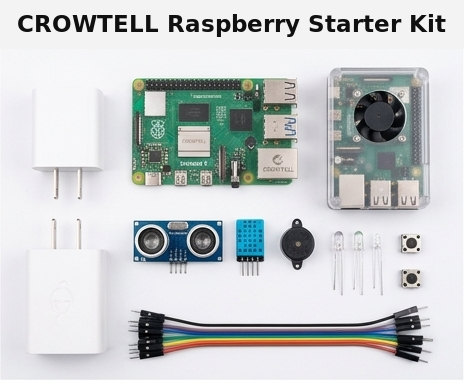
Kit overview
A full computing and hardware kit for advanced learners.
The overview presents the Raspberry Pi, power supply, protective case, ultrasonic sensor, DHT11, buzzer, LEDs, buttons, and jumper wires as one organized learning platform.
- Shows the computer and electronics parts together
- Helps students understand the kit before setup
- Supports both coding lessons and hardware extension work
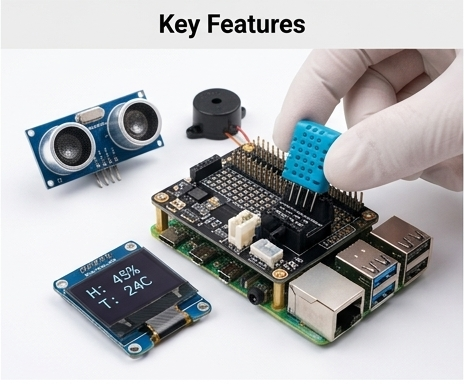
Key features
A bridge between software and real sensors.
Students use Raspberry Pi as a real computer while connecting GPIO-based electronics. This gives them a smooth path from Python or Scratch into sensor data, output control, and connected projects.
- Combines desktop computing with physical project work
- Supports Python, Scratch, Linux, and GPIO learning
- Good for older students ready for deeper engineering tasks
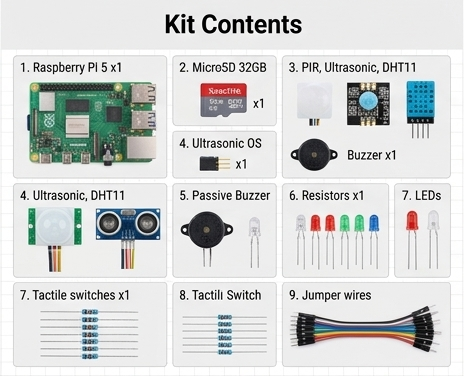
Kit contents
Core parts for computing, sensing, and control.
The kit includes Raspberry Pi hardware, MicroSD storage, a preloaded operating system option, display support, ultrasonic sensors, PIR motion sensing, DHT11, buzzer, LEDs, tactile switches, resistors, and jumper wires.
- Includes computing, storage, protection, and electronics
- Supports sensor projects and output feedback
- Organizes parts by the role they play in a build
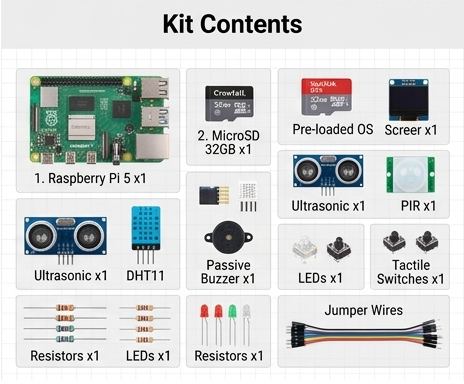
Detailed contents
Recognize each module before connecting it.
The detailed contents view separates the Raspberry Pi, MicroSD card, sensors, buzzer, LEDs, switches, resistors, and jumper wires into clear groups. This helps students identify parts and keep a shared workspace organized.
- Supports better classroom inventory management
- Gives students confidence before wiring components
- Pairs component names with visible hardware
Project example
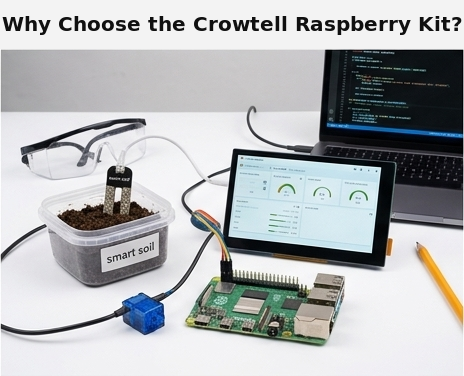
Create a smart soil monitoring system.
Students can combine sensor readings, Python logic, display output, and Raspberry Pi computing to build a smart soil project. It introduces monitoring, dashboards, and decision making in a practical environment.
- Turns coding into an environmental monitoring tool
- Connects sensor data to charts, screens, or alerts
- Works well as an IoT-style classroom project
Technical specifications
Introduce students to real computer hardware labels.
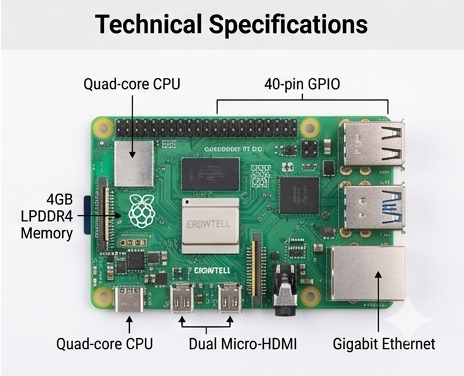
The technical specifications section highlights the Raspberry Pi board, GPIO header, memory area, processor, display ports, and network connections. It gives learners the vocabulary they need for more advanced hardware discussions.
- Shows GPIO, HDMI, Ethernet, memory, and processor labels
- Supports technical orientation before coding
- Connects kit projects to real computing concepts
Kit contents
A computer, sensors, outputs, and expansion parts.
- Raspberry Pi with official power supply
- 32GB MicroSD storage prepared for Raspberry Pi OS
- Protective case with cooling fan
- PIR motion, ultrasonic, and DHT11 temperature and humidity sensors
- Breadboard, GPIO expansion, jumper wires, LEDs, buzzer, switches, and potentiometer
Technical specifications
- CPU
- Quad-core 64-bit ARM Cortex-A processor
- Memory
- 4GB LPDDR4 SDRAM
- Display
- Dual Micro-HDMI with up to 4K support
- Interface
- 40-pin GPIO header for sensor expansion